How to find out which competitors ChatGPT recommends instead of my business?
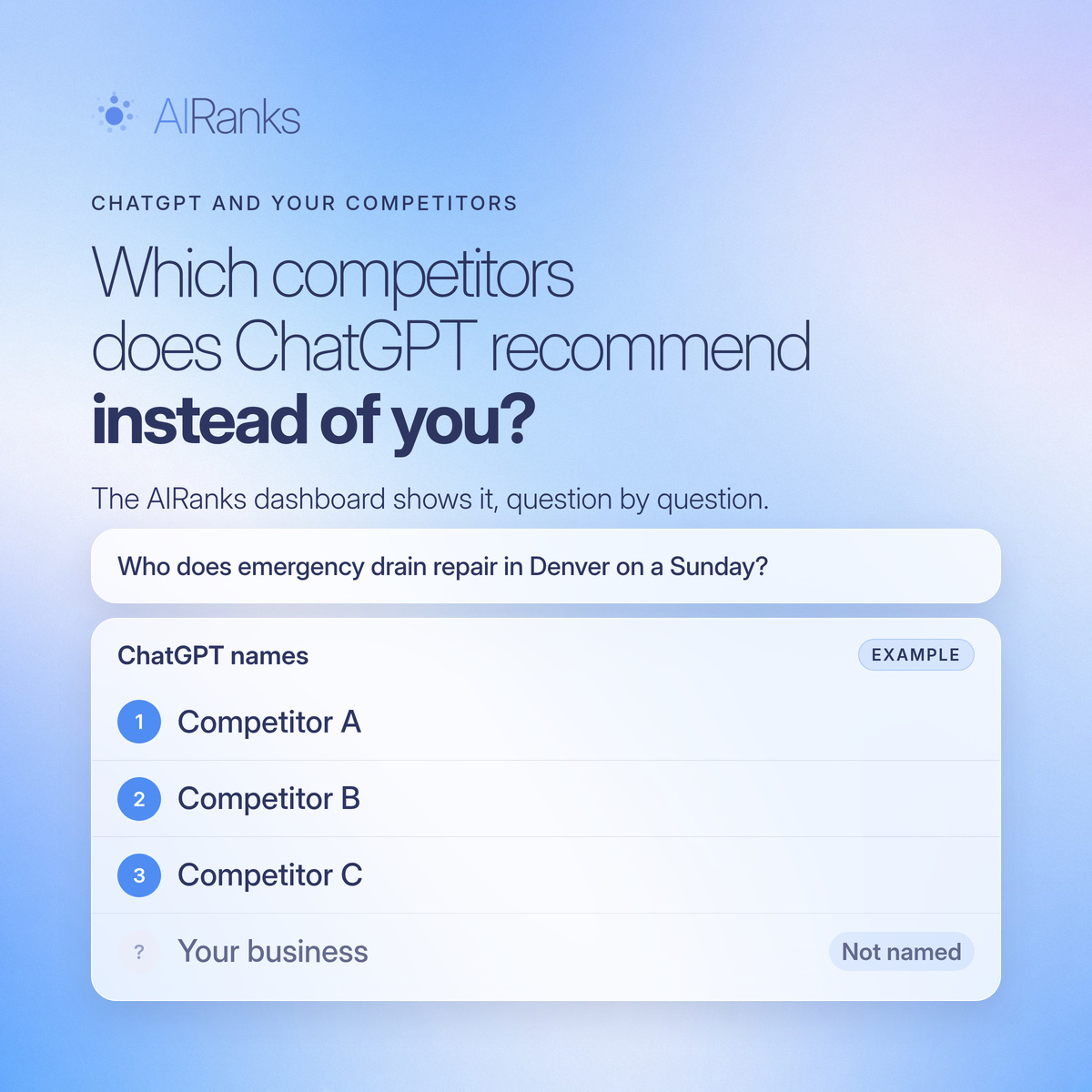
The AIRanks dashboard asks ChatGPT the questions your buyers ask every week and shows, for each question, where your business stands and which competitors were named instead.
On this page
The short answer: AIRanks shows you. The AIRanks dashboard asks ChatGPT the questions your buyers ask, every week, and for each question it shows whether ChatGPT named your business, your place in the answer, and the competitors it named instead. It does the same on Gemini, Claude and Perplexity. You can see a first version today: the free AIRanks scan runs 6 buyer questions on ChatGPT and Gemini in about two minutes.
Why asking ChatGPT "who are my competitors?" gives you the wrong list
It is the obvious first move, and it answers a different question. Ask about your business by name and ChatGPT tends to describe your category: the big brands, the companies that share your keywords, whoever your own website mentions. That is a market overview. Your buyers never see it, because they do not ask about you. They ask about their problem.
A buyer types something like "who does emergency drain repair in Denver on a Sunday?" and gets two or three names with a sentence about each. Those names are the competition that costs you the job, and they are often not the companies you would have listed yourself.
Plenty of buyers already choose this way. In BrightLocal's 2026 Local Consumer Review Survey of 1,002 U.S. adults, 45% had used an AI tool to get a local business recommendation, up from 6% a year earlier. ChatGPT was the most used: 31% had asked it for a business recommendation in the previous 12 months.
A single visibility score does not tell you who took your place. You need the question, the answer and the names side by side. The AIRanks dashboard is built that way.
What the AIRanks dashboard shows for each question
You give AIRanks your website and choose the buyer questions to track. AIRanks suggests them from your site and shows the Google searches behind each one (see How we choose the questions we track). It then asks every question on ChatGPT, Gemini, Claude and Perplexity once a week and reads every answer. Here is what you see.
Where you stand on every question
The Summary page has a table called "Where your brand appears this week". Each row is one of your questions, each column is an AI model, and each cell is your place in that answer: #1, #3, or a dash where you were not named. One look shows which questions you hold and which you have lost.
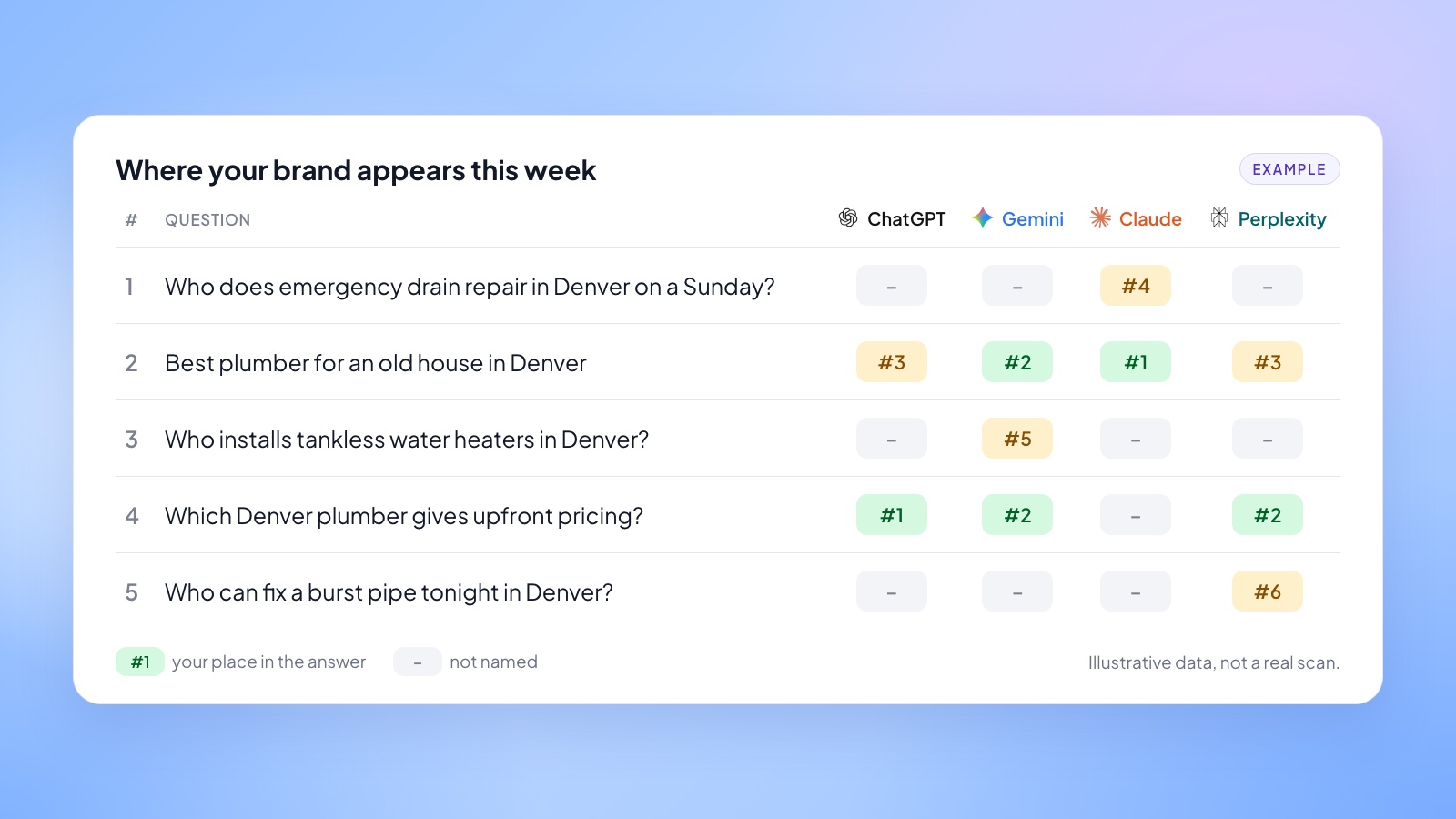
Under it, "Where you're missing" lists the questions where the AI models named competitors and never you, with their names beside each question.
Who ChatGPT puts ahead of you
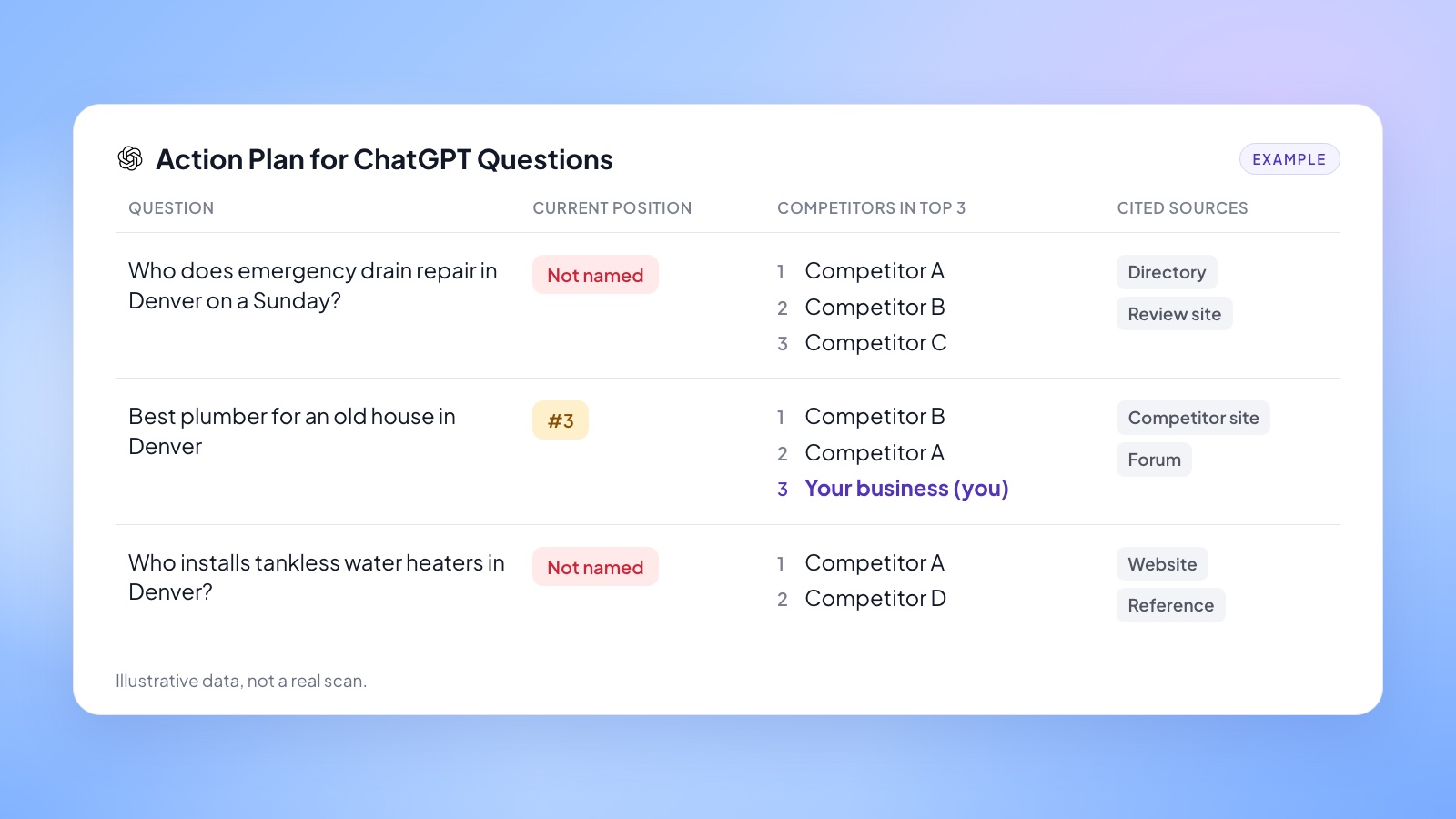
ChatGPT has its own page, and so does each of the other AI models. Its table lists every question with your current position, the competitors in the top 3 of ChatGPT's answer, the sources ChatGPT cited and a suggested action. This is the direct answer to the question in the title: the names, question by question, in the order ChatGPT gave them.
The full answer, and why you are missing
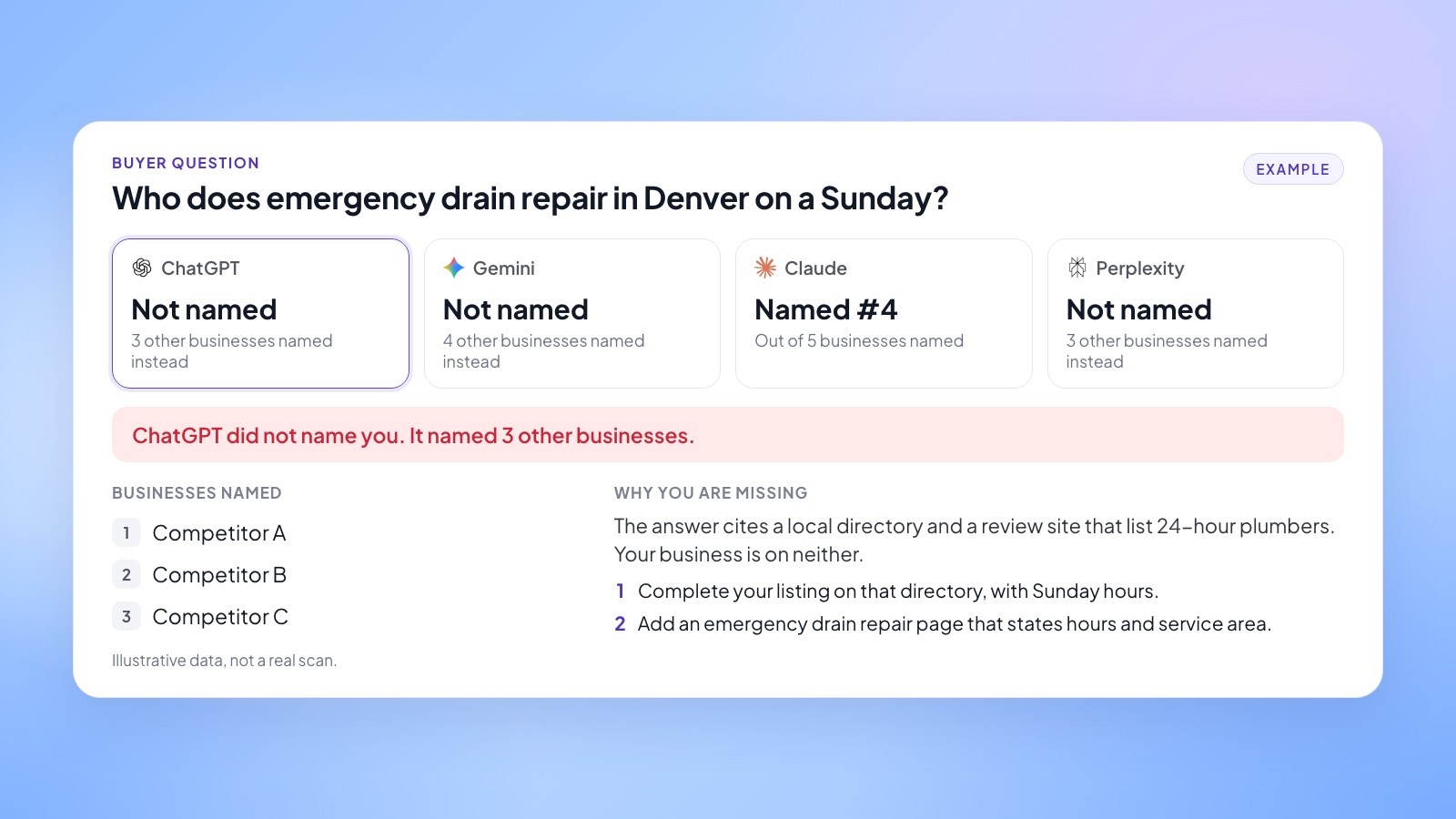
Open any question to read what each AI model answered, in its own words, with your business and every other business marked. A line above the answer states the result: "ChatGPT did not name you. It named 3 other businesses." Below it are the businesses named, in order, and the sources cited. You can put the AI models side by side.
The same page holds the action plan for that question: why you are missing, the next steps, and where to get mentioned.
The sites behind your competitors
The Sources page lists every site and page the AI models cited that week. One list is called "Sources that never name you": sites that shape the answers to your questions, where no answer that cited them named you. Those are the directories, review sites and articles to look at first.
The sources matter because of what research shows. Ahrefs' November 2026 study of 10,000 U.S. brands and 260 million non-branded AI prompts found that mentions on other websites tracked a brand's visibility in ChatGPT, AI Mode and AI Overviews. It is a correlation, and the authors say they cannot claim that mentions cause visibility. It still tells you where to look: at what other sites say about you, not only at your own pages.
What changed since last week
AIRanks asks the same questions again every week. The AI Visibility Score is a plain percentage: the share of that week's AI answers that named you. Beside it the dashboard says which questions moved, for example named in 2 new questions and no longer named in 1. A changed answer does not prove that one action caused it, and no one can guarantee that an assistant will name your business. You do see the change the week it happens.
Can you check this by hand?
Yes, once. It takes about an hour and a spreadsheet.
- Write 5 to 10 buyer questions. Each one should hold a service, a place and a need, in the words a customer would use. Leave your business name out.
- Open a temporary chat. According to OpenAI's Temporary Chat guide, a temporary chat started without personalization does not use your saved memories or custom instructions. That is closer to what a stranger sees.
- Put the city in the question. According to OpenAI's search guidance, ChatGPT can use location information for nearby results, so name the market you mean.
- Ask each question at least twice, in a new chat each time. The same question can return different names on different runs.
- Record every business named, in order, and the sources linked. Then count the answers that named each business.
The name that repeats in the answers that left you out is the competitor ChatGPT recommends instead of you.
The trouble is the arithmetic. Ten questions, asked twice, on four assistants is 80 answers to read and log, and you need all 80 again every time you want a comparison. You also test from one place, on one account, on one day. The dashboard does that work for you every week and keeps the record.
Start with the free scan
The free scan asks ChatGPT and Gemini 6 questions buyers ask about a business like yours, each one twice: 24 answers in all. It takes about two minutes and needs no card. AIRanks asks for an email so it can send you the result. You see whether your business was named, which competitors were named instead, and a first set of fixes. It is a sample, not a full audit.
The dashboard described above comes with a paid plan. Starter tracks 20 buyer questions for $39 a month on ChatGPT, Gemini, Claude and Perplexity, and asks them again every week. The full method is on How we measure.
What to do once you have the names
- Read the answers, not only the names. ChatGPT usually gives a reason for each pick: 24-hour service, a specialty, strong reviews. If that reason is true of you too and your website does not say so plainly, fix that first.
- Open the sources. If a directory, review site or local guide that lists many providers sits behind several answers, check that your listing exists and is complete.
- Check that AI crawlers can read your pages. Our free AI crawler check shows how they see a page.
- Look again next week. One changed answer proves little. The same change two weeks running is worth believing.
Do not try to manufacture the evidence. Fake reviews and planted forum posts are not the same thing as real customers talking about you, and they put the business at risk. For the wider picture, read How can my business get recommended by ChatGPT?
Frequently asked questions
How do I find out which competitors ChatGPT recommends instead of my business?
Ask ChatGPT the questions your buyers ask and record the businesses it names. The AIRanks dashboard does this every week: for each question it shows your place in ChatGPT's answer and the competitors named instead, and it keeps the full answer so you can read it.
Can I just ask ChatGPT who my competitors are?
You can, and you will get a general list for your category. It does not tell you who ChatGPT names when a buyer asks for a recommendation. For that, ask buyer questions that leave your name out and record every business in the answers.
Why does ChatGPT name different businesses each time I ask?
ChatGPT writes each answer fresh. The wording of the question, the location and the pages it finds on the web that day can all change the result. That is why one answer is not a verdict, and why the free AIRanks scan asks every question twice.
Does AIRanks only check ChatGPT?
No. Paid plans ask ChatGPT, Gemini, Claude and Perplexity every week, and each AI model has its own page in the dashboard. The free scan asks ChatGPT and Gemini.
Is the AIRanks scan free?
Yes. It asks ChatGPT and Gemini 6 buyer questions, each one twice, in about two minutes, with no card required. AIRanks asks for an email so it can send the result.
Can I pay ChatGPT to recommend my business instead of a competitor?
No. You can buy ads in ChatGPT where they are available, and they are labeled as sponsored and shown apart from the answer. According to OpenAI, advertisers cannot shape or rank the answer itself.